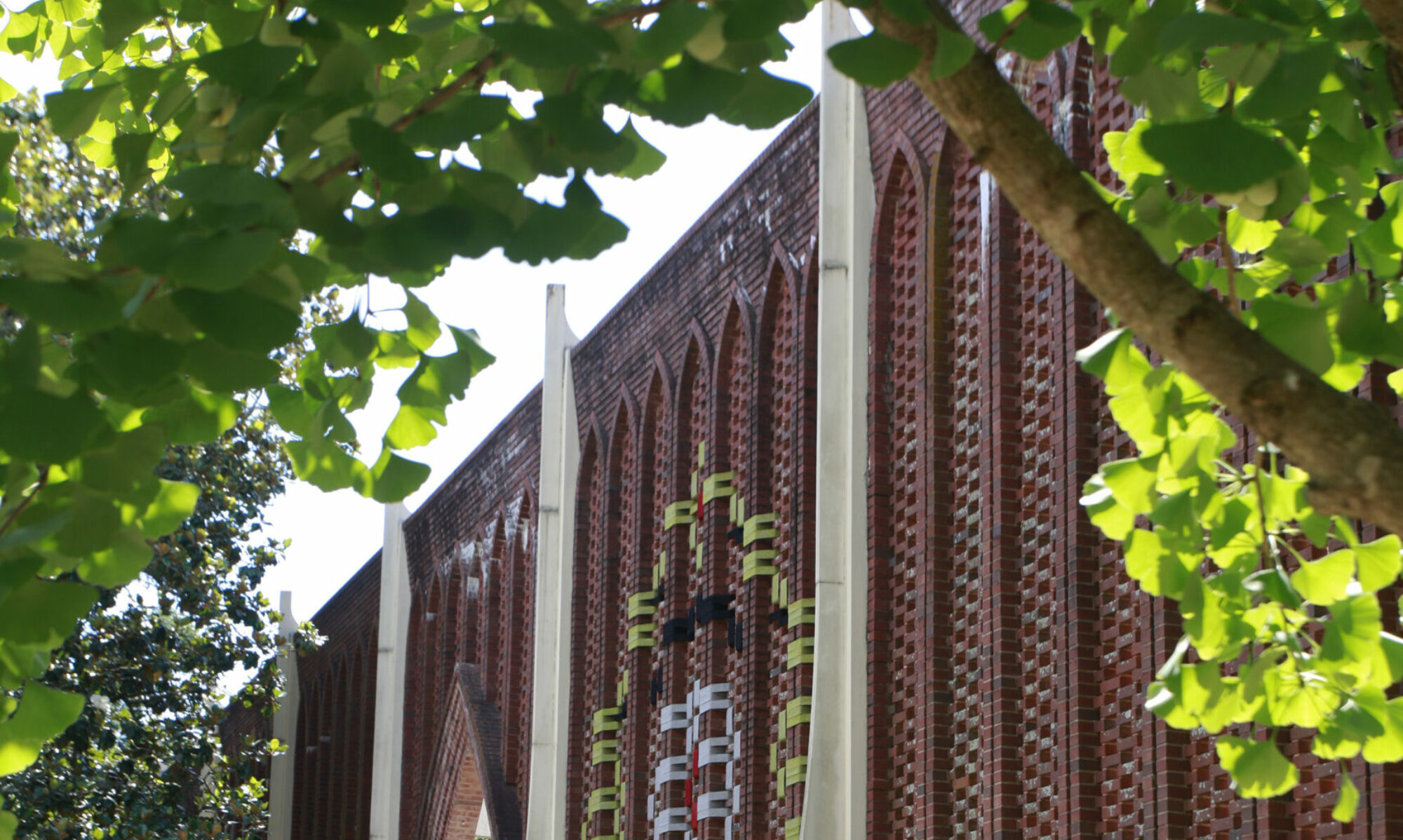
The Possibility of Framing Infinity

The Possibility of Framing Infinity on view spring 2008 curated by Lisa Alembik.

“Painting as a noun takes on limitless form and attitude. It can arouse visual pleasure, support a manifesto, tell a story and speak of ideas. It is carved out of history. As a verb, painting is a suggestive practice that unfolds and is often self-reflexive. It is about color and shape and the senses extraordinaire. A rich process of exploration can take place through the goop of the medium, the blending of pigments and energetic eye movement. In action, the painter’s scope of vision will enclose the picture plane like a web—or like the hot pinball machine of life. This process has the power to capture a point of view, cracking open space to produce new galaxies, often delving into the personal and unknown. Articulated and raw, restrained or whatever, painting at its best is a commitment that constantly poses questions.

The processes employed when painting can play a significant role in the development of any artistic work, infiltrating composition and method. This exhibit was inspired by this belief, that a painting sensibility, the dug-in knowledge developed through an intentional, prolonged experience of painting, can be expressed through a variety of forms and media. It is a way of thinking, of looking at the world that rests in composition. This idea allows for the making and exploration of culture with a focus on fluid form, light and material.

As this exhibition evolved, a certain sensation emerged from within the early gathering of artists, nothing out of the ordinary or uncommon, but a very strong binding sensibility. The exhibit’s founding premise, of bringing together artists working in a variety of media through a painter’s lens (or brush), became less of a priority than fostering this sensation, identified as the artists’ consideration of a limitless, never-ending continuum of space that changes with perspective, over time. The title, The Possibility of Framing Infinity, is meant to be open-ended as not to describe the artwork but the act of making.

For centuries artists have been working to express space and time—whether for a specific narrative or as a means to an end. Grounding this within the history of art, three artists or works of art are brought to mind. Consider the painting Mona Lisa (1503-1506) by Leonardo da Vinci (1452-1519). The sitter, with her enigmatic smile, is front and center, with rolling, misty hills disappearing into a diffuse background of atmospheric perspective. It has a sense of continuum, of forever, not only in the landscape but also within her visage. In the painting by J. W. M. Turner (1775-1851), The Burning of the Houses of Lords and Commons, October 16, 1834 (1835), which is exemplary of his work, the scene breaks into an intuitive deconstruction of the moment, with color and light telling the tale rather than an exact rendering of a historical incident. To Barnett Newman (1905-1970) whose paintings with “zips,” as he called them, begun in the 1940s, embedded the sublime into vibrating planes of color where the splits simultaneously break and hold his work into dense motion.

This framing of a place or body, whether it is a literal figurative point of view or a formless and intangible space can be experienced throughout this exhibit. In Colleen Lynch’s, Marcia Cohen’s and Caomin Xie’s paintings, a world is abstracted to come together into a meditative or ocular whole. A happening is described and re-scripted as it repeats through history—as the flood of Katrina is riffed and swelling in the sensory installation by John Otte. Jeremy Chance strives to disassociate himself from the potentially personal, emotional process of painting by honing in on headshots of actors portraying various expressions connected with depression, utilizing the distancing processes of printmaking to further himself from emotional stimulus. The picture plane, broken into a wake of formlessness, is reinvented and pulled together by the artist. Sally Heller creates environments of overgrown fuzzy and plastics stuffs that explode in space, with trees of PVC pipe, grass and mosses of pipe cleaners and Mylar pools of water. By framing these moments, space is re-shaped and transformed. For Sarah Emerson, the threshold of mortality is highlighted next to the unending unraveling coil of infinity in her existential explorations. Kristine Moran’s overflowing, unfolding worlds are empty of living human presence, where remnants of abandoned warehouses are overgrown with unbridled nature—flooded, iced over—still lit by the artificial glow of florescent lights.

Framing usually showcases something in its best light, possibly at its most effective essence. To frame infinity, to square off the limitless and timeless, is a bold endeavor.”

-Lisa Alembik, Dalton Gallery Curator 2002-2013

looking/longing

looking/longing on view Fall 2007

“looking/longing is simple in its premise,  offering a phenomenal experience of looking and a visual meditation on the potent power of the medium of photography.

We absorb our surroundings by reading clues of light bouncing off objects, our subconscious quietly processing the scope of our vision. When a person, landscape or object is immortalized through a photographic process, we may be enticed to look. We could be attracted just to know why the subject is significant to the photographer. If we are stirred, our attention held, a certain sensuousness of the medium and subject could continue to embrace our gaze to entice a deeper study.

Sensitive silver salts exposed to light will congeal to express a fugitive instant in two-dimensional form; the black and white negative: white values become dark and dark ones bright. A fertile moment condensed, framed and flattened—mediated. Complex worlds are pressed into these thin sheets of film.

The viewfinder brings into reach news of the nearby and faraway. Striving to read the history told by the image, we consider ourselves witnesses to times and people lost to us without the magic of photographic reproduction. For more than a hundred years, ‘we’ have come to know the ‘other’ and they us through the photograph. We allow ourselves to step into homes, spaces, dreams, histories.

Private and public spaces retain or create intimacy through the photograph. We become comfortable. The eye behind the camera directs our gaze, but in all fairness to the subject we cannot hold its truth as our own. Seeing is such a personal endeavor, eh? We might register the photographer’s point of view, but how we approach a photograph depends much on our personal visual histories. We are creatures who like to look, to watch, to stare even. We want to trust in the photograph, especially when beauty—qualified by the eye of the beholder, of course—is involved.

Ah, beauty—we fall all over ourselves to witness it, to gaze in awe and reverence. Its sweetness can be seen in so much of life: the soft curve of a back; the expression of spirituality; the open landscape; and youth. There is a strange flipside to such loveliness in the surrender to aging and mortality. Through the lens a mundane subject can become spectacular, elevated to the sublime. A landscape can become a mirror to hope. Sometimes the subject looks back through the frame, literally or figuratively, to step into the world of flesh—tugging at the gut, pulling at baser instincts. A glance intended for someone else can slice into a place that frames questions of knowledge and desire. Does the viewer have a sense of dissatisfaction in not being able to replicate that first look of the photographer? May be looking again, and again, one can slip into the image.”

-Lisa Alembik, Dalton Gallery Curator 2002-2013

Pink Days Azure Nights

Pink Days Azure Nights on view Spring 2006 curated by Lisa Alembik.

“This exhibition does not revolve around a theme. Pink Days, Azure Nights was borne from a call that brought forth artists unknown to the organizer in addition to new ideas from familiar ones.

This exhibition does not revolve around a theme, but connections are made. Is it something in the air, or burning questions that have evolved over centuries time of artists and culture makers? That which is occurring in the world around us is dredging up unavoidable complexities linked to raw emotion and new action. The volcanic eruptions and digging down of Julie Puttgen and Celeste Roberge knock on tectonic plates and a wryness of living. Anthony Greco reaches into the void fabricated from chaos, therein, finding a rhythm in the hurricane – the same form and energy inspiring Jennifer Beuno’s mirrored installation that projects our world fragmented into parallel systems, as she asks: “What do we desire?”; They think alongside Nell Ruby, who gives us a place to witness, a home/not-home made from sections and conflicting perspectives. As space unfolds, opening, the turning dancer in Hyun-Jean Lee’s video makes us feel connected, turning with her. Pieces segmented, running on and overlapping, cropped – still framing the simultaneously mundane and majestic moments of Terri Dilling, Brian Bishop, and Niklas Sven Vollmer. Fragmenting the moment is T.W. Meyer and Judy Parady, breaking things down to their smallest denominator. All of the artists in Pink Days, Azure Nights inspect how we look at our role in the world, or are told what our position should be – the often randomness of psychological diagnosis leads them to step into our spaces as we step into theirs.”

-Lisa Alembik, Dalton Gallery curator 2002-2013

limbs heart tongue & teeth

limbs heart tongue & teeth on view fall 2005 curated by Lisa Alembik.

“These fleshy vessels, our bodies, vehicles for our being, push into our surroundings. Form merges and turns as we respond to our environment. Moving, measuring time, we keep beat with our hearts. Gravity tethers us while the earth turns, propelled through space. We gather knowledge through our senses. Semi permeable membranes brush up against molecules that we inhale, absorb, sometimes reject.

How do we begin to understand our bodies? As babies we recognize ourselves as extensions of our parents’ hands, breasts, arms, feet. (Funny how as we age that knowing returns as sentiment when we see similarities in our own anatomy.) We learn about our apparent differences as children from our skin color to cultural or religious signifiers to our sex and size. All bodies cannot perform the same. Some require tools to operate. Some reside deep in their corporal form, grounded, breathing fully with their environs. The unbearable being floats above the body, unable to deal with mortal truths. Our body surrenders to thoughts and feelings, flooded with emotions that involuntarily take over the face or posture is determined by outlook. History, the brunt and joys of our experiences, mark the body.  If we live long enough time will lay her rage on our faces, sloughing away flesh or adding weight.“

limbs heart tongue & teeth presents artists who consider how deeply we understand our bodies and how we experience our relationship to our surroundings through these fleshy vessels. Different aspects of the body as phenomenon are addressed including body language, formlessness, disability and the religious body.

-Lisa Alembik, Dalton Gallery curator 2002-2013

Tender Landscapes

Tender Landscapes on view Spring 2004 curated by Lisa Alembik.

“Artists will tread the broad, awkward, often absurd boundary between humans and nature, negotiating various roles – mediator, interloper, documenter, amateur scientist. Some directly engage the land, feeling an undeniable bond because they, of course, are of nature. A sense of responsibility calls for them to be caretakers as best they can. They dig, peel, gather, nurture. The landscape, encompassing both flora and fauna, provides solace. The natural world enters their art through a deep understanding of the landscapes subtle and monumental power, and respect for human collaboration with the earth.

The artists in Tender Landscape responded to their natural environment through curiosity, humor, or empathy. A concern for how humans affect the environment, and in turn how the environment shapes us, is a current running through the works. These artists asked their audience to carefully inspect their surroundings, to look closely and listen carefully, and be aware of the possibilities held by all-encompassing nature.”

-Lisa Alembik, Dalton Gallery curator 2002-2013

css.php