Transcendent – Jordan Benator

Jordan Benator – she/her
 
My interest as a composer is in exploring creative ways for performers to interact with technology. Computers are powerful performance tools capable of incredible enhancement to live music, but a lot of works that take advantage of them only do so to add prerecorded backing tracks to their performances. This allows composers and arrangers to include sounds in their work that would be impractical, impossible, or inappropriate to be produced by a human musician, but it forces the performer to play in sync with a fixed piece of media assembled in advance, taking away agency and freedom of expression from the human performer. I am more interested in techniques that augment the capability of the performer without limiting them—paradigms in which the computer always works for the human, not the other way around.

Music for a Dark Corner is an interactive installation piece and an adaptation of Music for a Dark Room, a solo I wrote in 2018 for amplified coffee table and wiimote-tracked candle. Music for a Dark Room is a piece in which the majority of sound is generated by software, but every sound is initiated and controlled in real time by the performer. As the software tracks the location of the candle in space, the performer plays notes on a software synthesizer by moving the candle across the table. As the software amplifies and affects the table, the performer creates lush and eerie soundscapes by striking and rubbing against its surface. Near the climax of the piece, as the software shifts and distorts the sound of the performer’s own voice into something hardly recognizable, they recite an excerpt from the piece’s inspiration, Anna Anthropy’s hypertext game Queers in Love at the End of the World.

I wrote Music for a Dark Room about Anthropy’s game, which she describes as “a game about the transformative, transcendent power of queer love.” At the time I was 20 years old and convinced I was a straight boy, but I found the game deeply moving in ways I would fail to understand for at least another six months. As I’ve continued to perform the solo over the years, it’s felt as if Music for a Dark Room has transitioned along with me. It was always a piece of art about queer love, but now it’s about my own queer love, about the queer love I’ve had for others and the queer love I’ve worked to give myself as I’ve become myself. When I started working to alter my speaking voice to resemble that of a cis woman, the excerpt from the game that I quoted in the piece had of course already been committed to memory, and as part of my regular voice practice I began repeating this passage aloud every day, shifting and distorting it with my own body instead of with software.

In Music for a Dark Corner, the audience becomes the performer as they are given access to the performance mechanisms I developed and have come to know intimately since first performing the original work nearly 5 years ago. The table is amplified and its sound is processed so that every tap, flick, and scrape on its surface echoes for 60 seconds. Above the table is an infrared camera tracking the location of a flame on the table so that igniting and moving the lighter plays notes on a software synthesizer. Certain sequences of motions of the flame will trigger playback of voice memos I’ve recorded over the years as I’ve trained my voice. All recordings are of the aforementioned passage: “It’s so unassuming, her blushing, so sincere. You’ve disarmed her. Or have you given her the freedom to disarm, here at the end, where there’s nothing left to guard against?”
 
Jordan Benator is a 25-year-old amateur percussionist and composer, professional software engineer, and music school dropout. Jordan grew up frequenting the strip mall venues and repurposed church buildings that made up metro Atlanta’s DIY music scene before going on to study music composition and classical percussion at Georgia State University. She has since cultivated a notable presence within the city’s DIY scene, and her ensembles are working to expand their small following across more of the Southeast. In her own work Jordan continues to experiment in the space between the music of this local DIY scene and the greater American environment of contemporary “classical” music to which she was exposed in school, borrowing ideas and tropes from one to inject into her work for the other. In her spare time you’ll find Jordan singing and playing vibraphone in rock bands at local dive bars.

Transcendent – Layla Ali Amar

Layla Ali Amar she/they

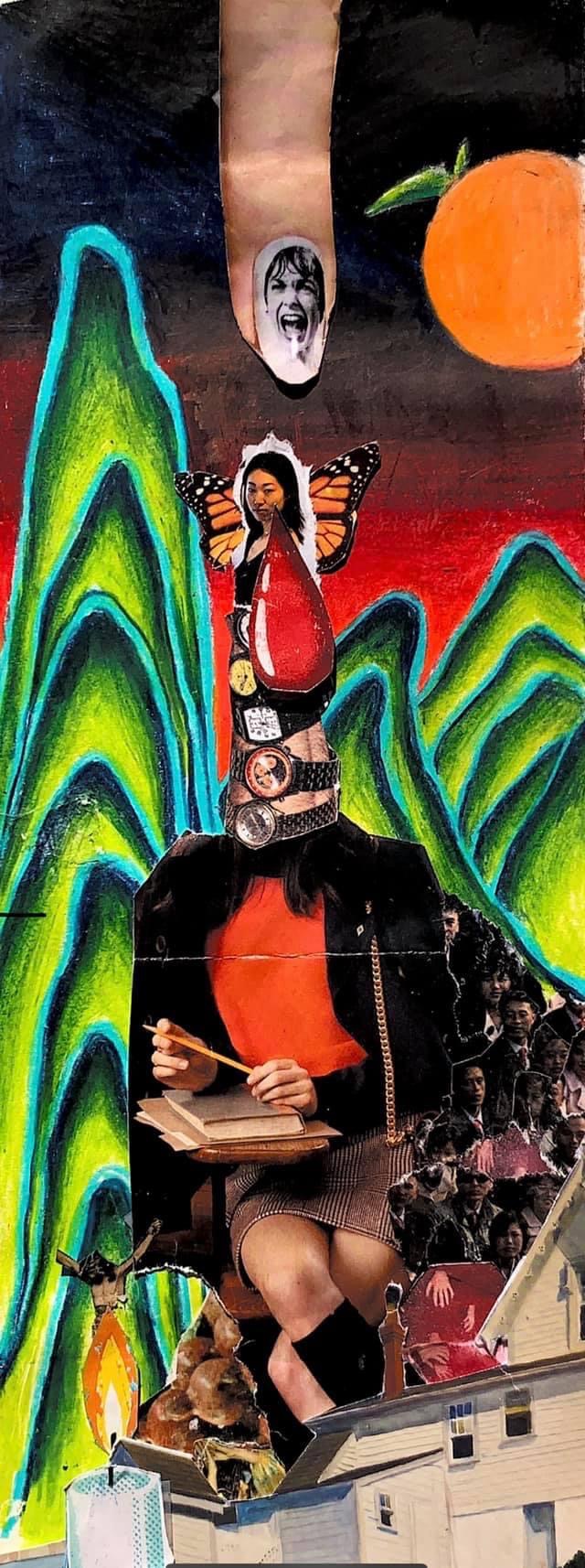
I talk to myself through my art. I have difficulty understanding how I feel, so my art is a map allowing me to explore my emotions safely. I believe we live in a state of instantaneous repetition. Each version of myself is always alive in a moment of singularity. My art is a pathway that reaches through these isolated frames and creates a communicative vessel. My intense layering and movement of color is a reach into the subconscious and rarely involves an active assertion of myself. I bring back a magical, colorful sense of self by reaching into these intangible states.

Layla Amar (b.1998) is a self-taught Palestinian-American artist born and raised in Atlanta, Georgia. She creates pieces compiled with layers containing multiple mediums such as ink, pastel, and paint. Focusing on drawing and painting, she explores communication with the self immediately after extensive disassociated states. Time dictates her work in that it is ever-present, proving that every traumatic event is constantly alive and replaying within the self. Her work uses mark-making in the pictorial space to articulate experiences within the traumatized brain to resolve the inability to label intense sensations. Overall, her practice investigates the intersection between inherited trauma, her Palestinian ancestry, and lived experiences.

Transcendent Artist & Curatorial Statements

Personal relationships with gender and identity are unique to every individual. Frequently these identities and experiences transcend the limits of language and semantic meaning. Showcasing visual work exploring artists’ personal relationships with gender, this exhibition will provoke visitors to think critically about what it means to be gendered in the world today and to reflect on their own relationship with gender.

Curatorial Statment

Select the artist name below for more information on their work.

Layla Ali Amar

Jordan Benator

August Fisk

Mitch Galiano

GETSAY

Alyssa Hood

Deborah Hutchinson

Edie Irwin

Emma Ming Kayhart

Kate Kosek

Pia Muhihu

Sara Murphy

Abigail Ranic

Salvi 

Royce Soble

Eliza Taylor

Julian Uhlman

Meganity Wattles

Running in the rain, falling in the ocean Artist Statements

Running in the rain, falling in the ocean curated by Zachary Francois of Prelude Pointe Gallery highlights the art of fiber artists whose work explores color theory through the use of textiles. Using fiber art techniques originating from Black people these artists use textile making as a form of healing and meditation. The result of this multi-media exploration yield bold and extraordinary pieces. 

This exhibition is the inaugural show in our new responsive gallery space, aimed at showing shorter-term exhibitions that are more responsive to our campus community.

Zami Aduna

Grief: 8-9 months old

Grief is a great friend. Dey don’t really like to talk, but say all dey need to.Even though Grief is ancient, dis version of dey body was built about 8 months ago. Before building their body, Grief gave me da following ingredients list: lavender, braiding hair, copper wire, thread, written messages(stuffed inside) and clothes gifted from someone who was no longer friends with me. It’s why i summoned Grief to begin with, to understand da shift between being connected with someone then just… not. i cried, dyed, wrote, ripped, cut,and sewed till Grief said “enough.” And i do these things all over when Grief says its time to visit again, mend again. In tending to my friend, i’ve sweetened my experience of lots of sour goodbyes. Grief don’t mind being close or visiting often, but gives very itchy and sharp hugs. It’s okay tho, da discomfort is a good reminder. So is da silence.

Artist Bio:   

Zami Aduna

pronouns: 

dey/dem

ki/kin

Zami Aduna is a 23 year old living in Maryland. Dey a student of death n growth, farmers n tailors, lies n love. Pieces shown r tools kin’s made to answer dey own questions. A copycat of nature n math, Zami takes whatever is around to build what dey need. These maps of memory and imagination are ever changing and transform (with) de artist. Thank you to all who make these processes possible. I’m grateful to be able to have made and to share these. If you want to help make these creative process easier for me or $end your feedback here are my paylinks:

cashapp: $rniang

venmo: @zamizami

Camisha Butler

Textiles are the silent, yet omnipresent companion of the human body. Life experiences can even be traced and documented through dress and decor. Fibers engage our lives on a daily basis, equally across race, class and nation, however, specifically, the Black American human-textile relationship is a sprawling tale steeped in lack, luxury, reclamation and identity. My work delves into this union through the utilization of craft as a means to preserve and honor familial lineage. As a bridge of remembrance to connect our past experiences to our future selves, I employ traditional craft methods such as embroidery, weaving, macrame and garment construction to tell the timeless stories of joy, resilience and self determination.

Artist Bio:

Camisha Butler is an emerging textile artist and craft preservationist, born and raised in Atlanta, Georgia. She earned her BA in Film at Georgia State University and a MS in Fashion Design with concentration on Costume History from Drexel University. Her work explores the human-textile relationship as it applies to the Black American cultural experience. She utilizes “Craft as Resistance” and Neo-Luddite philosophy through textiles, fibers and digital design to engage the joyful recollection of our collective memory and fantasy. Her work has been shown at The Bakery, The Hambidge Center’s Cross Pollination Lab, the Reginald F Lewis Museum and on the tv series, Ambitions.

Faith Icecold

Faith Icecold is a non-degree Black multidisciplinary craftsperson from the planet Earth.

Cashay Johnson

In my rope pieces I am using a technique called coiling. Coiling is the process of wrapping a smaller linear material around another, larger linear material—periodically attaching it to itself to create a dimensional form. In this technique I make emotional decisions about colors and textures. However, using long and tedious processes, which is common for Textiles, is a form of meditation for me. I commit to this process because it challenged me and expressed time; teach me patience, endurance, and intense focus, which gives me strength and provides perspective on other, more difficult aspects of my life. I want the viewer to see my patience, my endurance, and my strength through these abstract pieces.

Artist Bio:

Cashay Johnson is a fiber artist based out of Atlanta, Georgia. She attended Georgia State University, where she fell in love with fiber arts. She finds inspiration in shapes, colors, and textures. “When I see a fabric or textiles material that interests me, I think of all the art I can make with it. She explores traditional techniques such as Coiling and Weaving. She fell in love with textiles her junior year of high school, when she took a fashion design class. She specializes in dyeing natural fibers, coiling, weaving, and designing digital patterns using photoshop. Most of her influence comes from her surrounding and her emotions. If you want to find more of Cashay Johnson’s work or what she will be up to, you can follow her on Instagram at cashh_aristry.

Kimani Johnson

Black sexuality has been politicized for centuries. In the Pre-Antebellum era, Black people had
no sexual sovereignty and were labeled as overtly sexual creatures. During the late 19th-century “respectability politics” surfaced within the Black community to combat this
stereotype. Originating in the church, these social rules by design embraced the ideas of gendered and sexual normativity created by the patriarchy specifically for feminine behavior.
Those who did not conform ( queer folk, sex workers, etc.) to these rules were viewed as setting back the community. Many notable Black feminist critics view pornography as violent and harmful to Black women’s bodies. I want to show how the pornography industry has been a space where Black erotic autonomy is embraced; a space that provides Black women agency in fabricating their own images and expressing their desires. I use mediums that are traditionally viewed as ‘women’s work’ such as quilting and weaving.
With quilting, I use found quilts whose history I am unaware of, similar to the women in these images whose pasts are also anonymous. These naked women then appliqued on top of what appears to be your grandmother’s quilt creates a jarring juxtaposition. With weaving, I repurpose images that were intended for the male gaze to create unorthodox collages. My body of work is my ode to the Black women in porn who are resisting the system that disparages their worth, and a callback to the traditional structure of women’s work.

Artist Bio:

Kimani Johnson is an Atlanta-based artist who works with various textile media.Their artwork tells a story about their personal experience as a black and queer person. By focusing on techniques and materials, They make work that deals with self-documentation. The work tries to express this with the help of color theory and soft materials

Fall 2022 Exhibition Transcendent Call for Entries

The Dalton Gallery is seeking artwork for our upcoming exhibition- Transcendent. Artists creating visual work on gender identity and experience are invited to apply to this exhibition on view from September 20 to December 5. Applications are open through September 5 at bit.ly/DGtranscend For more information or if you have any questions please contact us at daltongallery@agnesscott.edu

Personal relationships with gender and identity are unique to every individual. Frequently these identities and experiences transcend the limits of language and semantic meaning. Showcasing visual work exploring artists’ personal relationships with gender, this exhibition will provoke visitors to think critically about what it means to be gendered in the world today and to reflect on their own relationship with gender. 

Stay tuned for more information on exhibition details and programming to come!

Dalton Gallery Covid-19 Visitation Guidelines

The Dalton Gallery of Agnes Scott College is excited to welcome you to view our fall exhibition, Transcendent in person starting on September 20. For the safety and wellbeing of our visitors, students, staff, and campus community, our COVID-19 visitation policy abides by regulations set by the Agnes Scott College COVID-19 taskforce. We ask that you observe all guidelines below and follow any requests made by our in person staff.

Agnes Scott College requires masks while indoors for all off-campus guests visiting the campus- masks are mandatory at all times while you are in the gallery. You will not be able to enter the gallery without a face mask.

Please reschedule your visit if you are feeling unwell or experiencing any symptoms of COVID-19 (fever, shortness of breath, loss of taste or smell, flu-like symptoms or general discomfort).

Surfaces and restrooms are cleaned and serviced between gallery visits.

If you have any questions about visits to the gallery please email acarnes@agnesscott.edu

On View: Can You Hear Us Now?

 Can You Hear Us Now?: Revolutionary Art of the Next Generation opens this Wednesday, March 30.

The Dalton Gallery of Agnes Scott College presents Can You Hear Us Now?, a student-designed exhibition displaying activist art made by young adults in the Atlanta Area. Can You Hear Us Now? aims to oppose historical and colonial institutional practices and the notion of the “neutral museum” by creating space for communities and conversations excluded from art institutions and to exhibit these conversations without expectations of neutrality. Alongside the exhibition, The Dalton Gallery will host conversations with local activist organizations and artists to allow opportunities for the community to engage with activists in Atlanta.  You can find more information on the exhibition website here. 

A project by the Department of Art & Art History this show is created by Art History major Lillian Jackson ’22. 

&yet again

The Dalton Gallery of Agnes Scott College presents a juried exhibition of work by young emerging artists from the Atlanta area- &yet again.

In January 2020 the Dalton Gallery of Agnes Scott College presented a juried exhibition of work by young emerging artists from the Atlanta area in collaboration with community partners. &yet sought to connect and foster conversations among young artists from communities around Atlanta. Thanks to our partnerships we were able to waive application fees in an effort to create an accessible opportunity for young artists as well as award cash prizes to artists selected by Agnes Scott faculty and our jurors.

We are excited to announce that &yet will be returning in January 2022!  Our free application will be open on callforentry.org until 12.31.21.

For &yet again we are expanding on the ideas presented in the first exhibition and augmenting the exhibition with a few new ideas we see as crucial to emerging artists. 

The application fee for this exhibition has been waived as an initiative to limit restrictions for applying for young artists. 

As a part of this exhibition, six $500 awards will be given out through juror’s awards and publicly selected people’s choice awards. 

This exhibition builds connections between artists of all backgrounds as well as members of the arts community. This exhibition will be juried by a panel of Atlanta Arts Leaders.

This exhibition is made possible by the James T and Ella Rather Kirk fund.

Late Night @ the Dalton Gallery

A multi-sensory installation of projections, video work, and fabric pieces, our fall exhibition, Strata, transforms from amazing to stunning once nighttime falls. We’re opening up the gallery for three nighttime visitation hours this fall so everyone can enjoy Strata in it’s fullest impact. Nighttime visits will be offered on 10/25, 11/13 and 11/29 from 7-9pm. You can register to visit on Eventbrite here. 

Can’t come for one of our later night events? No worries- the exhibition is just as impressive during our regular hours. You can schedule an appointment to come see the show through our other Eventbrite.

Visits to the gallery are by appointment only. No one will be admitted without an appointment. All visitors to the college are required to wear a mask at all times and will not be admitted to the building without proof of vaccination.

Strata

The Dalton Gallery and the Department of Art & Art History are excited to announce our fall 2021 exhibition on view; Strata. Strata is composed of site-specific projection artwork by Shannon Collis. You can book your visit today and read our current Covid-19 safety policy here. 

Strata, a project by interdisciplinary artist Shannon Collis, is an immersive exhibition offering a means of experiencing subtle interactions between sights and sounds to understand the sonic and spatial complexities of the remote regions of the Athabasca Oil Sands. 

For Strata, Collis collected audio and visual material in areas of the western Canadian province of Alberta to create an exhibition centered on regional oil industry activities, examining consequential environmental issues.  

The result of her work—including large-scale video projections mapped onto various-sized planar forms, as well as surround-sound audio that permeates the exhibition space—provides visitors with an immersive experience as they contemplate the moving images. The footage collected onsite is the source material for the installation—a sensory map of regional, industrial, and natural environments. Collis invites audiences who may otherwise be unable to see or hear the complex story of the Athabasca Oil Sands to enter and investigate the constructed sensory space. 

Moving away from the space of the flat screen and toward creating multimodal and immersive physical environments that highlight the embodied experience of hearing and seeing, this work seeks to build a deeper connection between the sensing body and the world, blurring the lines between physical and digital spaces while heightening participants’ awareness of their environment.

Strata is on view 9.20.21 through 12.7.21.

2021 Decatur Fine Arts Exhibition

The Dalton Gallery is excited to host the annual Decatur Fine Arts Exhibition by the Decatur Arts Alliance once again. The 2021 Fine Arts Exhibition will be on view Thursday-Sunday from 12-4pm. You can reserve your ticket here. Make sure to mark your calendar for the Last Call reception on June 13, 2021 from 4-6pm. 

Per City of Decatur ordinance and Agnes Scott College campus policy masks will be mandatory for entry into the gallery for the safety and wellbeing of our staff and community. 

Spring Student Showcase ART 340 & 460 Drawing

This section contains the work from ART 340 & 460 Drawing and Composition taught by Professor Anne Beidler. 

Allison Aguilera, Chrissy Erickson, Emily Findlay, Kayla Ishmael, Taylor Jones, Breanna Madison, Anabel McGinnis, Kaitlyn Murdock, Rebecca Oliveira, Nyla Taylor, Emma Zelski, Karen Galiano, Amya Moore.

Spring Student Showcase – ART 244 Digital Processes spring

This section contains work by the students in the spring section of ART 244 Digital Processes taught by Professor Nell Ruby.

Spring Student Showcase – ART 160 Visual Thinking fall

This section contains the work from the fall class of ART 160 Visual Thinking taught by Professor Nell Ruby.

Spring Student Showcase – ART 344 Advanced Digital Process

This section contains work by the students of ART 344 Advanced Digital Process taught by Professor Nell Ruby. 

Spring Student Showcase – ART 244 Digital Processes fall

This section contains the work from the fall class of ART244 Digital Processes taught by Professor Nell Ruby. 

css.php